MATT BARGAR · CREATION NOTES
Four Lines of Light: four voices, one complete journey
The brief
Matt asked for the next MATT BARGAR album to sound like a string quartet. Then he added the important part: each piece should have its own identity, while the overall arc should flow and feel complete. That became the organizing constraint for Four Lines of Light. The instrumentation stays small. The ways the four voices relate to one another change.
The result is an eight-movement, approximately 33-minute instrumental LP built from an original event score and recorded solo-string samples. It is not a recording of a quartet playing together. Two independently programmed violin parts, one viola part and one cello part make up the entire instrumental cast. There are no drums, synthesizer pads or hidden orchestral sections filling gaps. Space is part of the arrangement.
One idea, eight different situations
The shared melodic germ rises through D, E and F toward A, then falls through G and E to D. Its character is simple enough to survive changes of register, rhythm, mode and speaker. The score also contains seven related melodic cells. The opening contour returns near the end with F raised to F-sharp: the final movement does not merely replay the opening in the same emotional light.
The harmonic and rhythmic plans are defined separately for each movement. This is not one accompaniment pattern stretched across eight filenames. The middle of the record becomes sparse before it becomes abrasive; the cello then takes over the work of rebuilding a melody. The fast penultimate movement provides the outward release, leaving the ending free to become quiet.
1. A Room Before Speech At a base tempo of 66 quarter notes per minute, the first violin begins with the other voices entering gradually. A slow four-beat song establishes the album's vocabulary. Long lower-string notes support a melody whose rhythm alternates between held tones and shorter connecting gestures. The ending leaves breathing room rather than cutting to the next file.
2. Small Agreements The pulse shifts to three beats at 92. Most of the movement is pizzicato: plucked fragments are distributed between the players instead of all four attacking every beat. Two bowed passages interrupt that dry texture. The contrast is in how a note speaks and who gets to finish the thought, not just in a new key or a faster metronome marking.
3. The Fifth Step Five-beat bars at 110 create a deliberately uneven stride. The upper parts use quick fragments with staggered entrances, while viola and cello articulate longer spans underneath. A slower-moving upper voice in the central passage interrupts the running surface. This is an algorithmically arranged fugato-like texture, not a claim to a rigorously worked academic fugue.
4. Where the Bow Waits The viola becomes the main voice at 54. This is the still center of the LP: the cello appears on alternate bars, the upper violins answer infrequently, and phrase endings leave actual gaps. It is intentionally the quietest and least dense movement. Silence here is not a failed download or missing part.
5. Grain Against Grain Seven eighths grouped as 2+2+3, a Phrygian pitch collection, close upper-string intervals, and clipped bowing roughen the surface. Plucked lower notes keep the pulse legible. A sustained middle passage interrupts the short attacks, and the upper voices withdraw near the end. Its sharper peaks were retained within the shared album headroom, not flattened to match the quieter movements.
6. What the Cello Remembers The cello finally carries the song. During the central span its melodic degrees are inverted before the original direction returns. The higher voices leave openings so the lower melody does not have to fight through four equal layers. Four-beat phrasing at 84 gives the record steadier ground after the uneven meters of the earlier movements.
7. Four Doors Open The quickest movement, in three at 126, contrasts short articulations with a long bowed middle section. The first violin later climbs into a higher register as the ensemble gathers. The objective is an expansive penultimate peak, not an ending that has nowhere left to go.
8. The Light We Leave The opening contour returns in D major at 62. The final eight bars simplify to spaced statements of the tonic harmony, with a gradual slowing and a quiet tail. Familiar material now has a different third, different pacing and the weight of the intervening movements behind it. That is the proposed resolution of the arc; whether it feels earned is ultimately a listening judgment.
How the sound was made
ChatGPT wrote a deterministic Python composition program that emits a score containing pitch, onset, duration, velocity, voice and bow/pluck articulation for every note. Separate MIDI files preserve the four instrumental parts for further work. The MIDI contains the base tempo; the rendered audio adds the bar-level timing changes and instrument treatment described below.
The violin source is VSCO 2 Community Edition, released under CC0 by Versilian Studios. Viola and cello use isolated solo notes from the University of Iowa Musical Instrument Samples. The Iowa library permits project use without restrictions. Source performers are credited in the release credits as library performers, not as people who played on or endorsed this album.
A custom Python/NumPy sampler selects a nearby recorded pitch and resamples it to the requested note. Long bowed notes extend with overlapped sustain windows when necessary. The program trims recording pre-roll, shapes attacks and releases, applies modest dynamic envelopes and gives the four voices separate stereo positions. A short set of low-level reflections supplies a chamber-like space. These are production choices, not a recording of a particular room.
The timing is mostly shared so the ensemble stays together. Small independent entrance offsets keep every bow from landing at precisely the same instant; gentle bar-level timing variation, phrase-end breaths and final slowing shape the larger line. One common output gain preserves the relative quiet and force of the movements. There is no LANDR mastering or other external mastering pass.
What this approach cannot claim
A sampled note cannot anticipate the next note the way a player can. This realization does not contain recorded legato transitions, continuous bow pressure decisions or four musicians responding to one another in real time. The selected Iowa isolated-note files use a forte layer; quieter expression is programmed rather than newly sampled at softer dynamics. Long sustains may reveal their repeated source window. These limitations belong in the account of how the record was made, alongside the useful control the method provides.
Technical verification covers decoding, duration, metadata, signal peaks and lossless equality. It does not establish that a human listened all the way through or that the simulation is indistinguishable from a live ensemble.
Words and image
Each movement has an original companion lyric written with ChatGPT. No words are sung or spoken on the recording; the text is supplied separately so the quartet remains instrumental.
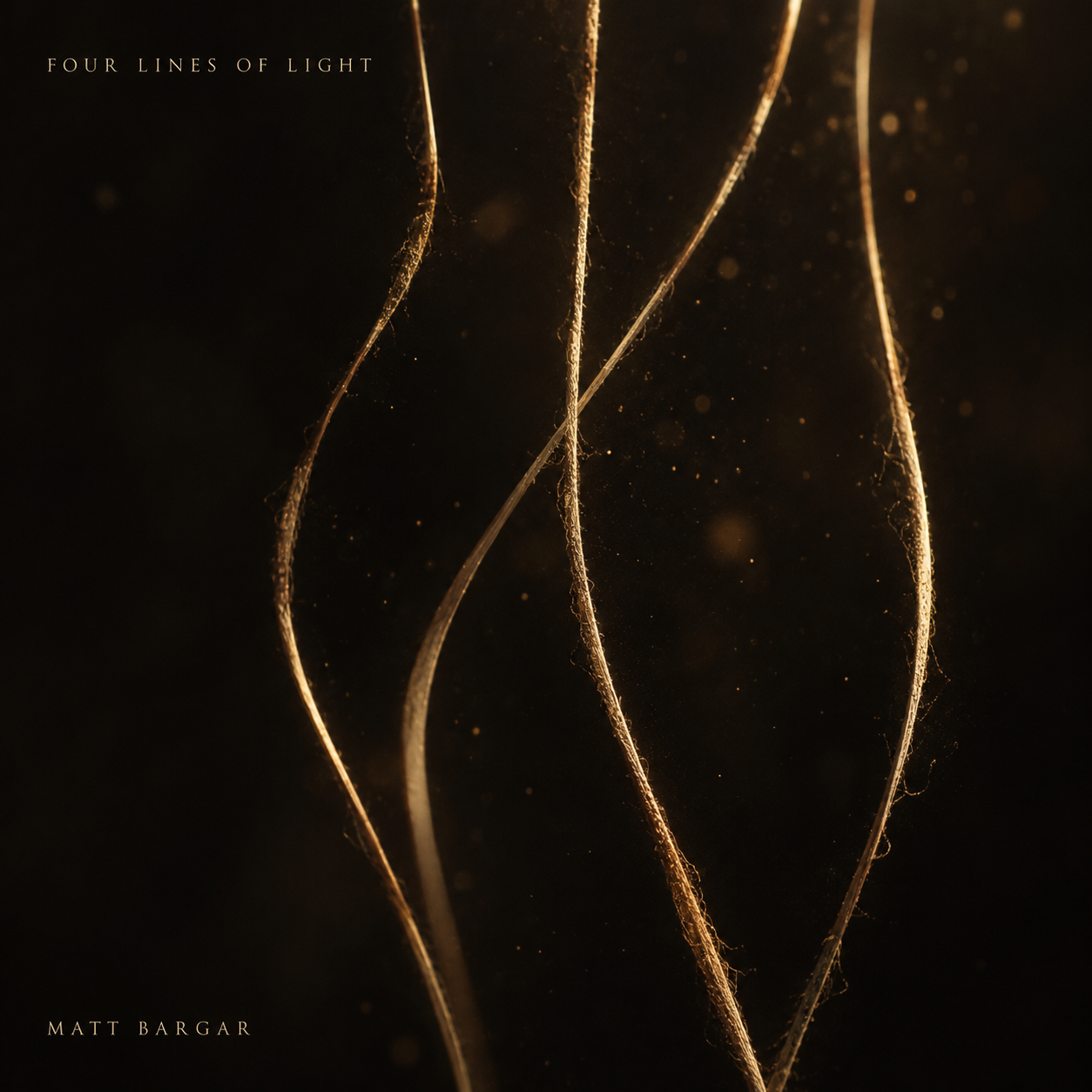
Matt's usual direction is to begin the cover with one of his existing artworks. For this release the specified iCloud artwork library contained placeholders but no image that could be opened locally. The attempted source was 20201005-2020-10-05_16-45-51.png. It was not read successfully, copied into the cover process or altered. The fallback cover is therefore an original ChatGPT-generated image, not a transformation of Matt's artwork. Four thin ivory-gold threads, warm black space, faint wood grain and dust translate the four-voice concept into an abstract image. MATT BARGAR appears in the requested all-capitals spelling, without a period.
Files, costs and the next use
The rendered masters are 24-bit, 44.1 kHz stereo PCM. The downloadable FLAC files are encoded from those WAV masters, not from the smaller AAC listening files. Decoding FLAC back to PCM is checked against the corresponding WAV. The album archive includes the cover, companion lyrics, credits and this article. The original composition data and production provenance are retained locally. No original Matt files are replaced.
There were no new direct purchases for this release: no paid samples, hired players or mastering charges. That is not a claim that existing subscriptions, computer resources or future manufacturing are free. This website edition does not imply a streaming-store release or physical editions are available.
For the procedural game, the useful material is not simply a 33-minute file. The score has four addressable roles, defined articulation changes, variable density and recurring motifs. A future game-audio implementation could move between sparse, conversational and agitated states while keeping a recognizable theme. That remains an application to build and test; this album does not claim that the game's adaptive music system has already been implemented.
Listen and download: https://bargar.art/music/four-lines-of-light/ Created with ChatGPT. Creative direction: Matt Bargar. Release artist: MATT BARGAR.
Sources and sample permissions: https://github.com/sgossner/VSCO-2-CE https://github.com/sgossner/VSCO-2-CE/blob/master/LICENSE https://theremin.music.uiowa.edu/MIS.html https://theremin.music.uiowa.edu/MISviola2012.html https://theremin.music.uiowa.edu/MIScello2012.html