MATT BARGAR · PROCESS NOTES
A little space unfilled.
Inside Violet Hours: eight electronic pieces, made from oscillators, deterministic noise, and an original piece of art.
Violet Hours moves from stillness into rhythm and back into open air. It is an album built around a gradual change of attention: a suspended opening, a pulse taking shape, a sideways step, a moment of momentum, and an ending that leaves room around the listener. The eight separate tracks run 32 minutes and 43 seconds.
This account describes the saved composition source and release files. It is not a fictional studio diary. Created with ChatGPT for MATT BARGAR, the album was composed and rendered with custom Python and NumPy code, then encoded with ffmpeg. No recorded band, hired singer, sample pack, GarageBand session, Ableton session, or LANDR AI mastering was used.
One arc, eight rooms
The Room Before Light opens at 76 BPM, using the album’s ambient vocabulary before a more assertive rhythm enters. Glass Has a Memory brings a 96 BPM dub-inflected pulse. Velvet Switch moves into swung, broken patterns at 112 BPM. Rather than keep escalating, A Door Made of Air changes the gait: three beats to the bar, at 84 BPM.
Night Orchard is the most direct four-on-the-floor passage, at 124 BPM. Unwritten Streets returns to broken rhythm at 102 BPM; The Shape of Staying settles into an 88 BPM dub form. Leave the Window Open closes at 72 BPM, returning to ambient space. The tempo sequence is not a continuous DJ tempo map. Contrast is part of the arrangement, and the transitions let each track keep its own character.
Each composition has eight formal stages: opening, statement, development, lift, a negative-space break, transformed return, summit, and dissolution. The code changes energy across those sections. That affects which instruments appear, how strongly they are played, and how densely the motif speaks. The break is deliberately less crowded; the return is changed, not merely copied.
Making the instruments
The sounds begin with mathematical oscillators. Pads combine a slowly modulated sine wave with a slightly detuned partner and quieter upper harmonics. Their gradual attack and long release let chord changes overlap. Bass uses a strong fundamental with small second- and third-harmonic contributions, a short attack, and a decaying envelope.
The bell voice uses phase modulation that fades with time, plus a nearly fourth-harmonic overtone. The plucked sound loses brightness and amplitude quickly. A reed-like voice adds odd harmonics and vibrato, providing a longer melodic line during the lift, transformed return, and summit. These are synthetic instruments; “reed-like” describes their sound, not an acoustic performer or a sampled instrument.
Percussion is synthesized too. The kick has an integrated downward pitch sweep, with a brief noise component at the attack. The snare combines differentiated noise with a decaying tone. Hats use short, bright noise envelopes; the rim sound pairs two rapidly decaying sine tones. A fixed random seed for each track controls variations, making the render reproducible rather than dependent on an unrecoverable lucky take.
Repetition with room to move
Harmony is organized into four-chord cycles. Different tracks and sections select different progressions. A short motif provides continuity, but its pitches are mapped to nearby chord tones. The transformed return shifts its indexing; probability controls whether a particular note is present. The result is rule-based variation inside a deliberately limited vocabulary.
Broken and dub passages delay selected offbeats slightly. Bass phrases include rests, and the beginnings and endings stay relatively sparse. Small percussion fills appear at chosen eight-bar boundaries, while a high overtone marks some of those larger units. Stereo panning varies individual melodic events without randomly relocating the entire arrangement.
Space comes from multiple delayed copies of the atmospheric instrument bus. Some taps are linked to the current beat, others use fixed times; selected taps swap the stereo channels. There is no endlessly accumulating feedback loop. The dry and delayed signals are combined, and the original tracks receive a three-second fade-in and eight-second fade-out.
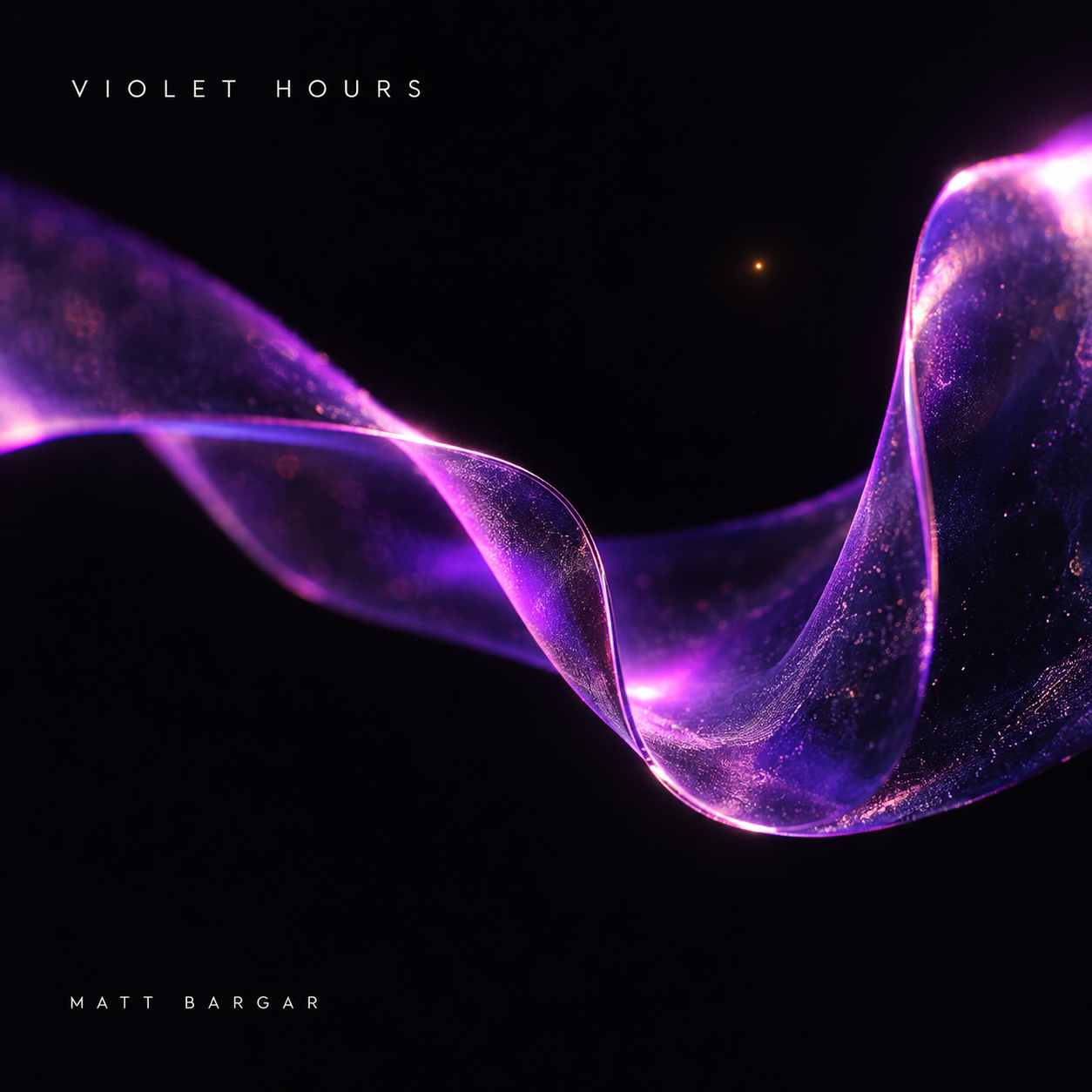
The artwork comes from Matt’s work
The visual seed was Matt’s 20260921-gradient.png. It was inspected and left unchanged. The new cover takes its violet and magenta glow, curved energy, and dark-to-light contrast as a starting point. It does not reproduce the seed’s signature, framing, or composition.
The resulting image imagines a translucent glass ribbon floating in darkness, with one amber point. The cover was developed using an image-generation tool with the inspected artwork as a reference. That relationship carries into this page: deep negative space, violet accents, restrained lettering, and the artwork allowed to remain the central image.
Words without pretending there is a singer
Original companion lyrics were written for every piece. They are available with the release, but the audio is instrumental: there is no recorded singer, voice clone, or synthetic speech performance. The opening lyric includes “I leave a little space unfilled.” That phrase also describes the intended relationship between the music, the artwork, and the page.
Read the companion lyrics. They are a parallel text to the music, not a transcription of something being sung.
Listening and keeping a copy
The web player offers the complete tracks in sequence, with soft transitions. Where browser autoplay and volume controls permit, it overlaps adjacent tracks using equal-power fades. Individual controls remain available for choosing a track or seeking within it. Mobile browser restrictions can require an additional tap; they should never be disguised as a completed transition.
The downloadable FLAC files preserve the original 24-bit, 44.1 kHz stereo PCM masters. Lossless means the decoded samples match those masters, not that a compressed listening copy has been enlarged. Each FLAC is checked against its source WAV using decoded-audio hashes. The download package includes the cover, lyrics, credits, and a link back to this album’s permanent page.
What the checks do—and do not—prove
The original rendering normalized each track’s sample peak to approximately −1.31 dBFS. AAC listening copies were fully decoded and checked for expected duration, finite nonzero samples, and clipping. A spot measurement of Velvet Switch reported −18.08 LUFS integrated loudness, −1.31 dBTP, and an 11.2 LU loudness range. That was a measurement, not additional mastering, and it is not an album-wide loudness certification.
These checks establish useful technical facts. They do not prove emotional impact, listening-room translation, or anyone’s subjective acceptance. No claim is made that a distributor has approved the album merely because it is available here. There were $0 in new purchases or hired services for the original creation run; existing subscription usage is not being represented as free infrastructure.
What this teaches a procedural game
The useful separation is between musical decisions and sound rendering. Harmony, density, motif, and formal section can be represented as state; the synthesizer turns those decisions into sound. Stable seeds can make a particular variation repeatable, while phrase-boundary changes help an interactive director avoid arbitrary musical cuts.
Separate percussion, bass, harmony, and motif stems would make a future adaptive version more flexible. Preserving envelopes and tails matters just as much as selecting the next chord. These are lessons and possible next steps from the source—not a claim that this album is already integrated into a game.
Credits
Release artist and creative direction: MATT BARGAR.
Created with ChatGPT: composition and arrangement, sound-design programming, companion lyrics, artwork development, and production documentation/support.